Medical Frailty Evaluation
Medicaid medical frailty determination from claims and encounter data — built for H.R.1 implementation.
Built for H.R.1 implementation — January 2027 federal deadline
LLM-powered clinical review — catching what rules alone miss — available on a limited basis.
States and Medicaid managed care organizations must identify enrollees who are medically frail and therefore exempt from Medicaid work and community engagement requirements. Each evaluation runs a deterministic rules pass, then an AI clinical review (LLM) on the same claims—so staff see both the compliance outcome and when the rules engine may have missed a qualifying pattern.

40M+
Medicaid expansion adults subject to new work requirements
38 states
Building medical frailty systems from scratch under HR1
$270M
Estimated per-state cost of manual IT system builds
Jan 2027
Federal deadline for state compliance
The January 2027 deadline is real
Pennsylvania DHS is actively designing a claims-based ICD-10 medical frailty review process with a January 2027 go-live target. Commonwealth Fund reports that most states need entirely new IT system builds to identify medically frail enrollees, with cost estimates from under $10 million to over $270 million per state. AgeOptions notes that policy experts recommend developing coding systems and specialized algorithms using diagnostic and service utilization data to identify medically frail individuals, and warns states to carefully choose technology vendors given costly failures in Medicaid IT. Health Affairs states that medical frailty implementation has been scattershot, and says states must rethink how this exemption is implemented before the deadline. ASAM explains that federal law requires states to use available data to determine exemption status without requiring additional documentation from enrollees—ex parte verification first. That is why the next section explains why claims data matters.
As cited by leading health policy organizations
Why claims data matters for medical frailty
Federal statute recognizes medical frailty as an exemption from Medicaid work reporting. Operational success depends on using Medicaid claims and encounter data before asking enrollees for more paperwork.
Medically frail Medicaid enrollees are exempt from work and community engagement requirements—but only when the state or plan can identify them accurately and on time.
Requiring enrollees to self-attest or submit physician forms drives churn: people who meet medical frailty criteria still lose coverage during application or redetermination.
Medicaid eligibility and MMIS systems need repeatable logic—ICD-10 diagnosis codes, utilization thresholds, and lookback periods applied the same way for every enrollee.
Workflow
How medical frailty determination works
Every search runs two automated passes—deterministic rules first, then AI clinical review—before staff review claims and export evidence.
Select member and evaluation mode
Choose Renewal or New Application mode — the member dropdown filters to only matching members. Renewal evaluates existing claims history; new application flags results as advisory and routes insufficient-history cases to manual review.
Retrieve Medicaid claims
Pull MMIS or managed care encounter and EOB data for the selected member across the configured lookback period. Claims retrieved count is shown separately from claims evaluated.
Rules engine (deterministic)
Match ICD-10 diagnoses to the medical frailty condition library and return Exempt or Not Exempt. Classifies every exempt result as permanent (chronic), temporary (acute only), or indeterminate — and runs a separate 90-day hardship pass that can flag HR1 review regardless of the main outcome.
AI clinical review (LLM)
After the rules pass, AI clinical review runs automatically — Pattern Consistent, Review Recommended, or Low Confidence — with reasoning and suggested conditions. Never overrides the rules outcome.
Review evaluation trace
Staff review the Evaluation Trace showing claims retrieved, conditions matched, frailty classification, any hardship indicators, AI review result, and final decision — all in one collapsible timeline before approving.
Approve and save to member record
Click Approve & Save to write the determination outcome directly to the member's exempt status via the members API. Closed-loop workflow — no manual data re-entry, no separate system update.
Clinical data layer
Five data sources. One modular architecture.
Every source has a defined API contract and returns a consistent response shape. Today all five run against synthetic data. When a data sharing agreement is signed or credentials are configured, only the endpoint or flag changes — not the interface, not the evaluation logic.
MMIS
Medicaid Management Information System
Explanation of Benefit and encounter records from the state Medicaid claims warehouse. The primary evidence source — every evaluation starts here.
Data provided
- Claim type (inpatient, outpatient, ED, SNF, HHA)
- ICD-10-CM diagnosis codes per claim
- Service dates and procedure flags
- Configurable 1–24 month lookback window
Connected today via deterministic synthetic MMIS data. Replace the endpoint with your state MMIS or data warehouse URL — no interface changes.
P3N HIE
Pennsylvania Patient and Provider Network — Health Information Exchange
Real-time clinical events exchanged through regional health information organizations across Pennsylvania. Supplements claims with recent encounters not yet visible in billing records.
Data provided
- Recent inpatient admissions and discharges
- Emergency department visits
- Outpatient encounters with diagnosis codes
- Days since encounter for recency scoring
Requires a signed data sharing agreement with PA DHS and P3N onboarding. Returns synthetic encounter data today.
MCO HRA
Managed Care Organization — Health Risk Assessment
Functional limitation and care management data from managed care organizations at enrollment. Contains ADL impairment and frailty indicators not visible in claims.
Data provided
- Risk level (low, medium, high)
- Functional limitations with severity and ADL impact
- Frailty indicators and chronic conditions reported
- Care management enrollment and complexity tier
Requires individual data sharing agreements with each managed care organization. Returns synthetic HRA data today.
Applicant Info
Member-Provided Documentation
When administrative data is insufficient for a determination, members submit documentation directly. Manages physician attestations and supporting records for new applicants.
Data provided
- Physician attestation letters and attestation date
- Conditions attested by treating provider
- Documentation request and receipt status
- Pending actions and next steps for staff
No external data sharing agreement required. Returns synthetic documentation status today — wires to member portal when built.
Argyle
Employment Verification — Argyle API
Fetches real-time employment status, income, and paystub history from payroll systems. When a member is terminated or earning below threshold, the evaluation surfaces a CE Relevance hardship indicator alongside the claims-based outcome.
Data provided
- Employment status (active, terminated) and type
- Employer, job title, hire and termination dates
- Base pay rate and bi-weekly gross/net paystubs
- Low-income and termination hardship flags for CE determination
Runs on Argyle's exact API schema today — all fields, pagination, and response shapes match the live API. Set ARGYLE_ACTIVE=true and provide credentials to switch to live payroll data. No interface or evaluation logic changes.
Modular by design
Swap the endpoint. Keep everything else.
Each data source is a standalone API with a defined request and response contract. The evaluation engine reads from those contracts — it does not care whether the data comes from a synthetic endpoint, a state MMIS, or a live HIE. When your integration agreement is signed, you update one URL. The rules engine, the audit trail, the UI, and the downstream member status update all stay exactly as-is.
// Today — synthetic endpoint
endpoint: "/api/mmis-eob-retrieval"

// After agreement — live MMIS
endpoint: "https://mmis.state.gov/api/eob"
Limited availability
LLM Clinical Review
The rules engine is your compliance record. The LLM layer is the safety net for the cases that matter most—built and in production, available to pilot partners on a limited basis.
Shipping now
Deterministic rules engine
- Matches ICD-10-CM codes and claim patterns against CMS chronic condition exemption rules in your database
- Enforces inpatient, outpatient, and procedure thresholds per condition
- Returns a defensible medically frail / not medically frail outcome with full claim-level evidence
- Classifies every exempt result as permanent, temporary, or indeterminate — guiding the appropriate exemption period
- Detects short-term hardship events (hospital admission, ED visit, surgery) in the last 90 days and surfaces an HR1 flag even when the main rules return not exempt
- Supports application and renewal evaluation modes with distinct logic, advisory caveats, and member filtering
- Every determination is auditable — the rules engine is the legal record
Limited availability
AI clinical review in the workflow
- Runs automatically on every evaluation immediately after the deterministic rules pass
- Large language model reads diagnosis and utilization context like a clinician reviewing the chart—not a lookup table
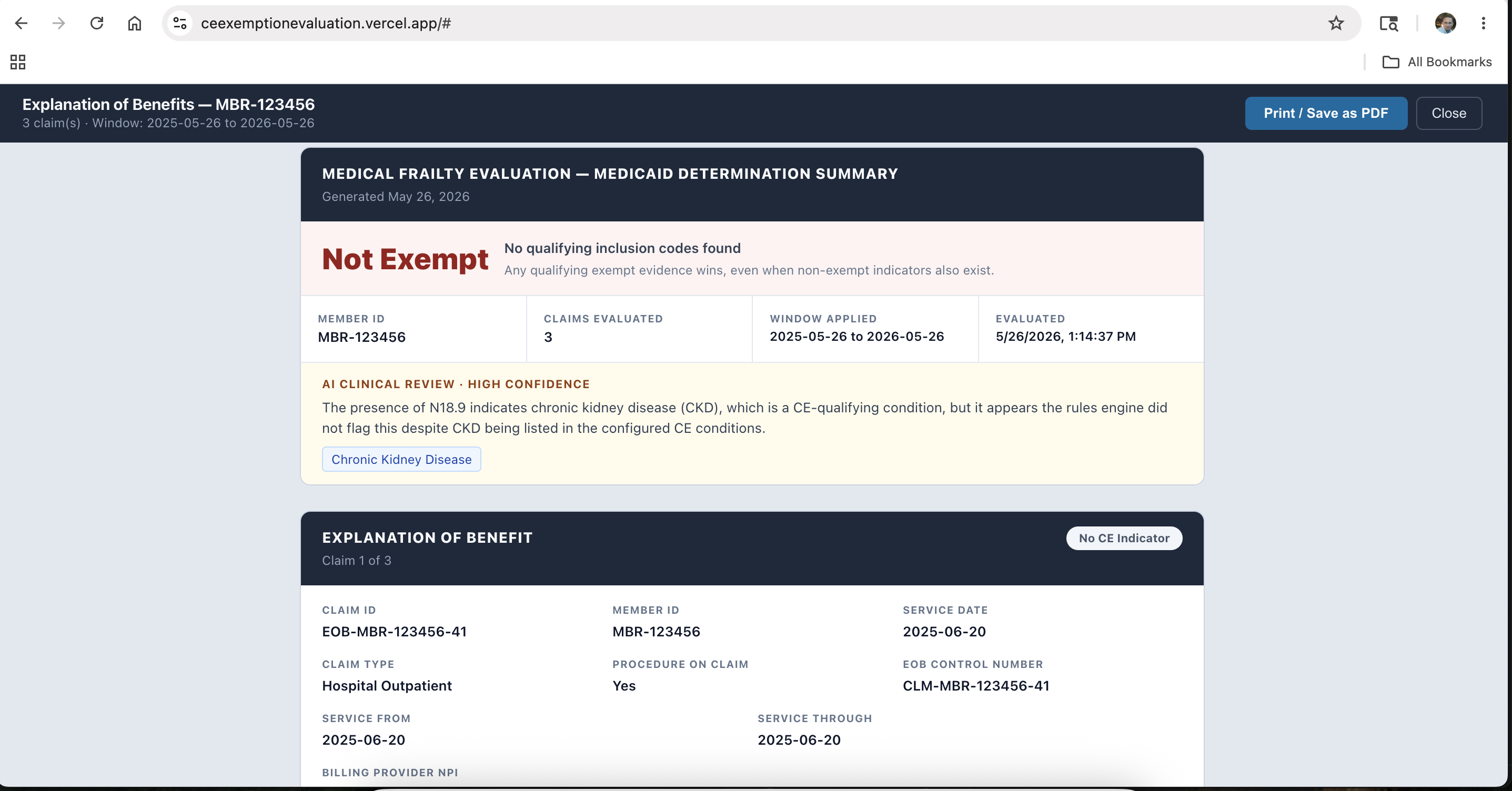
- Surfaces the AI Clinical Review banner with confidence, reasoning, and suggested conditions in the UI
- Never overrides the rules outcome; routes uncertainty to eligibility staff for human review only
Why the second pass matters
A missed medical frailty finding can mean a Medicaid enrollee loses coverage when they should be exempt. The LLM layer catches those cases before they become fair hearings.
The rules engine must stay authoritative for compliance; the LLM layer catches clinical patterns the code list has not caught yet and sends them to a care manager or eligibility worker.
- —Code combinations that together indicate serious illness but do not match any single condition list
- —New or revised ICD-10 codes not yet loaded into included/excluded tables
- —Clinically catastrophic patterns that have not been added to state rules yet
- —False negatives: engine says not medically frail when a care manager would disagree—the highest-stakes miss
In the API, the same workflow returns llm_review alongside the rules outcome—review flag, confidence, and reasoning for staff, not an automated override. Enabled for limited pilot deployments today.
Built for Medicaid eligibility and MMIS operations
Deterministic rules for the compliance record, plus AI clinical review on every run so staff see when code-table logic may have missed a medically frail pattern.
Eligibility lookback periods
Server-enforced 1–24 month windows aligned to how states apply medical frailty at application, renewal, and redetermination.
Medicaid claims evaluation
Processes MMIS-style EOB and encounter layouts with ICD-10-CM matching, inpatient/outpatient thresholds, and procedure-based rules.
AI clinical review (LLM)
Runs on every evaluation after the rules pass. Displays an AI Clinical Review banner with confidence, narrative reasoning, and suggested conditions—without overriding the deterministic outcome.
Medical frailty conditions
Evaluates the full CMS chronic condition exemption catalog in one pass—serious and complex medical conditions, substance use disorders, and disabling mental disorders.
Defensible audit trail
Returns matched conditions, qualifying claim IDs, diagnosis codes, and policy text for Medicaid compliance and fair hearings.
State-configurable rules
Chronic condition and ICD-10 mappings maintained centrally so states can align with their medical frailty definition without code changes.
Eligibility system integration
REST API for Medicaid eligibility and MMIS batch jobs, plus a review UI for eligibility staff and managed care care management teams.
Member roster integration
API-driven member dropdown pulls directly from your Medicaid member roster. Staff select members by name or ID — no manual entry, no transcription errors, no mismatched records.
Closed-loop status update
Approve & Save writes the determination outcome directly to the member's exempt status via the members API. Evaluation results flow into the member record instantly — no separate system update required.
Permanent vs. temporary frailty classification
Every exempt determination is automatically classified as permanent (chronic conditions), temporary (acute events only), or indeterminate. Guides staff on the correct exemption period without manual review of underlying conditions.
Short-term hardship detection
Detects recent hospital admissions, ED visits, and surgeries within a 90-day window and surfaces an HR1 hardship indicator banner — even when the rules engine returns not exempt. Catches enrollees who qualify under hardship criteria before an incorrect denial.
Application vs. renewal evaluation mode
Two modes with distinct logic: renewals evaluate against existing claims history; new applications flag insufficient claims history for manual review and treat results as advisory. Members are filtered to the correct mode automatically.
Modular multi-source data layer
MMIS, HIE, MCO Health Risk Assessment, and applicant-provided documentation each run as a standalone API with a defined contract. All four are queried in parallel on every evaluation. Switching from synthetic to live data means updating one endpoint URL — the evaluation engine and UI stay unchanged.
Employment verification via Argyle
Fetches employment status, income, and recent paystubs from payroll systems via the Argyle API. Termination or income below threshold automatically surfaces a CE Relevance hardship indicator alongside the claims-based determination. Operates on a synthetic data layer today — switching to live Argyle credentials requires only a single environment flag with no code changes.
Member-provided documentation upload
When administrative claims data is insufficient — typically for new applicants — care managers upload physician attestations and supporting records directly in the evaluation UI. Documents are captured with attestation date, physician name, specialty, and notes, then stored for compliance review. Supports PDF and image formats.
Review UI
Rules-first decisions—with a clinical safety net
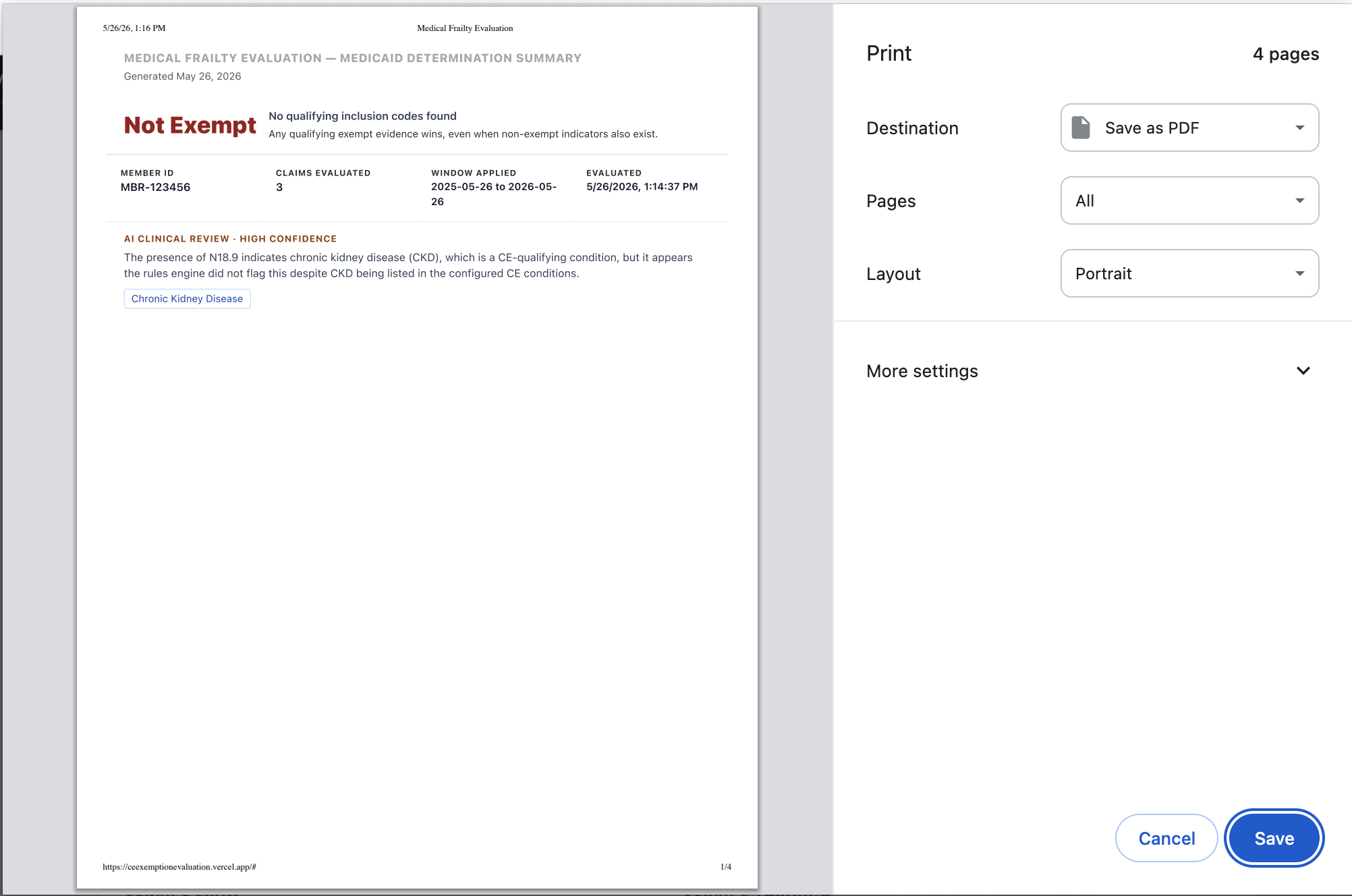
After each search, staff see the rules outcome and the AI Clinical Review banner in the same screen—then qualification evidence, claim drill-down, and PDF export. Screenshots below follow that order.


For Medicaid IT
Integrate with eligibility and MMIS
Connect batch jobs from Medicaid eligibility systems, MMIS, or managed care data warehouses—or use the interactive demo for business validation.
Endpoints
- POST
/api/mmis-eob-retrievalMedicaid EOB/encounter history for an enrollee and date range
- POST
/api/evaluate-v2Medical frailty evaluation with server-enforced eligibility lookback
- POST
/api/evaluatePrior version — FHIR EOB or pre-parsed Medicaid claims
- GET
/api/icd-lookup?codes=I21.09ICD-10-CM code descriptions for analyst review
- GET
/ce_service/membersRetrieve Medicaid member roster for dropdown population and member lookup
- PATCH
/ce_service/members/:id/exempt-statusUpdate member exempt status after staff approval of determination outcome
- POST
/api/p3n-hie-retrievalPennsylvania Patient and Provider Network (P3N) Health Information Exchange — recent encounters and diagnoses. Returns synthetic data until PA DHS agreement is signed.
- POST
/api/mco-hra-retrievalManaged Care Organization (MCO) Health Risk Assessment — functional limitations, risk level, and care management enrollment. Returns synthetic HRA data until MCO agreements are signed.
- POST
/api/applicant-info-retrievalMember-provided documentation — physician attestations and documentation request status for new applicants. Internal workflow, no external agreement required.
- POST
/api/employment-verificationEmployment status, income, and paystub history via Argyle API. Returns terminated/active status, base pay, and bi-weekly paystubs. Exact Argyle schema today — set ARGYLE_ACTIVE=true to switch to live payroll data.
- POST
/api/upload-documentUpload physician attestations and supporting records for new applicants. Accepts PDF and image files encoded as base64. Stored in member_documents table for compliance review.
Production API hosts and credentials are provided to authorized state and plan integrators. Contact us for a Medicaid pilot environment, or use the live demo with synthetic claims.
Example request
curl -X POST https://your-deployment-host/api/evaluate-v2 \
  -H "Content-Type: application/json" \
  -d '{
    "member_id": "MBR-123456",
    "window_months": 12,
    "claims": [
      {
        "claim_id": "CLM-001",
        "claim_type": "IP",
        "service_date": "2026-03-15",
        "icd10_codes": ["I21.09"],
        "has_procedure_code": true
      }
    ]
  }'
Security and Medicaid compliance
Designed for programs where medical frailty determinations must be traceable, access-controlled, and supportable in eligibility records.
Controlled Medicaid access
Signed-in access for eligibility and care management staff. Production API access is limited to authorized state and managed care environments.
Determination audit log
Each medical frailty run records enrollee ID, outcome, matched chronic conditions, and timestamps for Medicaid quality and compliance review.
Configurable frailty rules
Chronic condition exemption and ICD-10 mappings are maintained centrally so states can align with their medical frailty policies without redeploying code.
See Medicaid medical frailty determination in action
Use the public demo with synthetic Medicaid claims, or contact us for a guided walkthrough, pilot access, and eligibility system integration planning.